
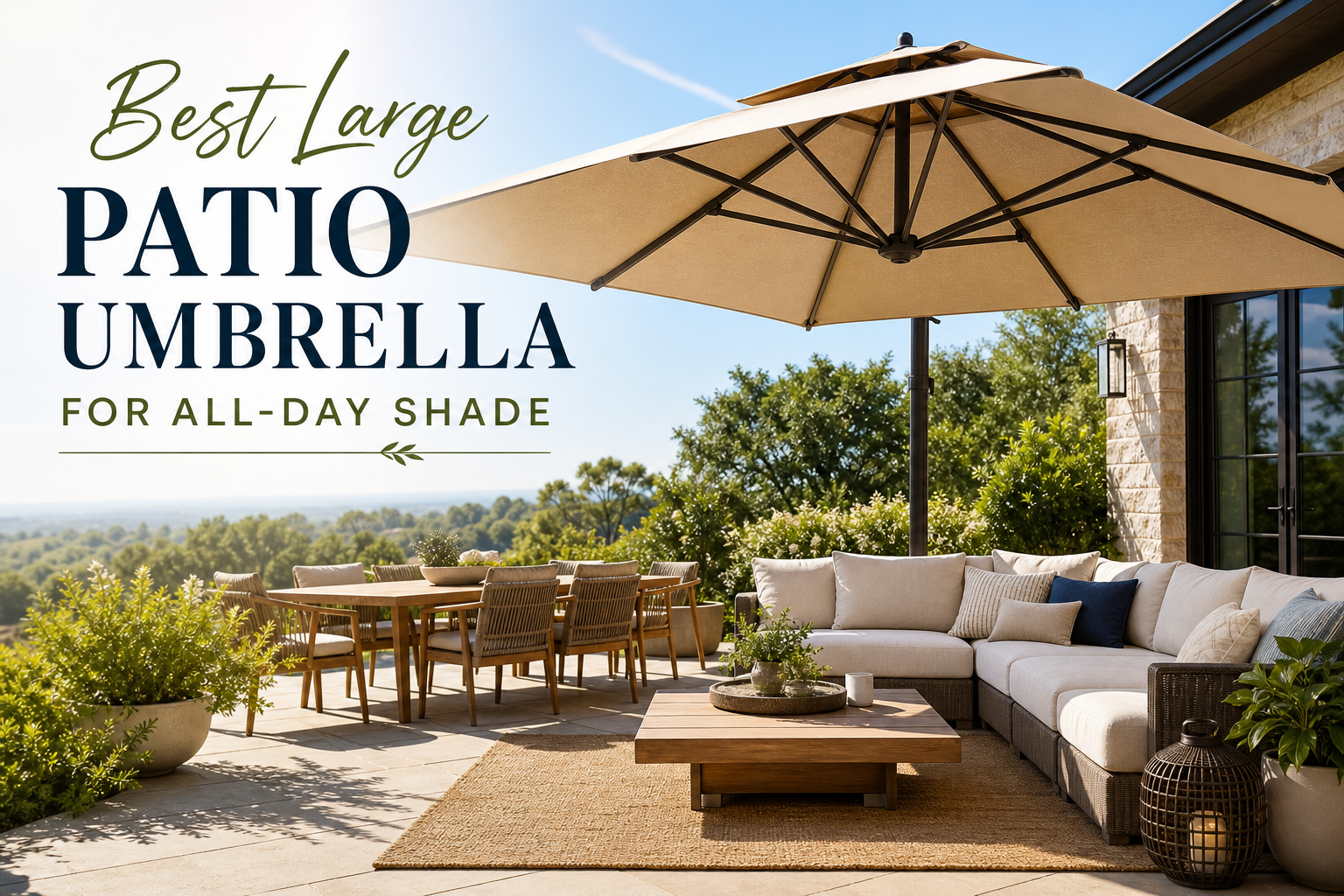
A large patio umbrella is a practical way to add reliable shade to outdoor dining, lounge areas, pool decks, and commercial seating—without permanent construction. With the right canopy size, stable support, and fabric choice, you can improve comfort, protect outdoor furniture from direct sun, and create a defined, relaxing shade zone.
- What Is Considered a Large Patio Umbrella?
- How Large Should a Patio Umbrella Be?
- Market Umbrella vs. Cantilever Umbrella
- Choose a Canopy Shape That Matches the Space
- How Heavy Should the Umbrella Base Be?
- Consider Wind Before Choosing the Largest Canopy
- Select Durable Canopy Fabric
- Useful Operating Features
- Placement and Clearance
- Care and Maintenance
- Final Buying Checklist
What Is Considered a Large Patio Umbrella?
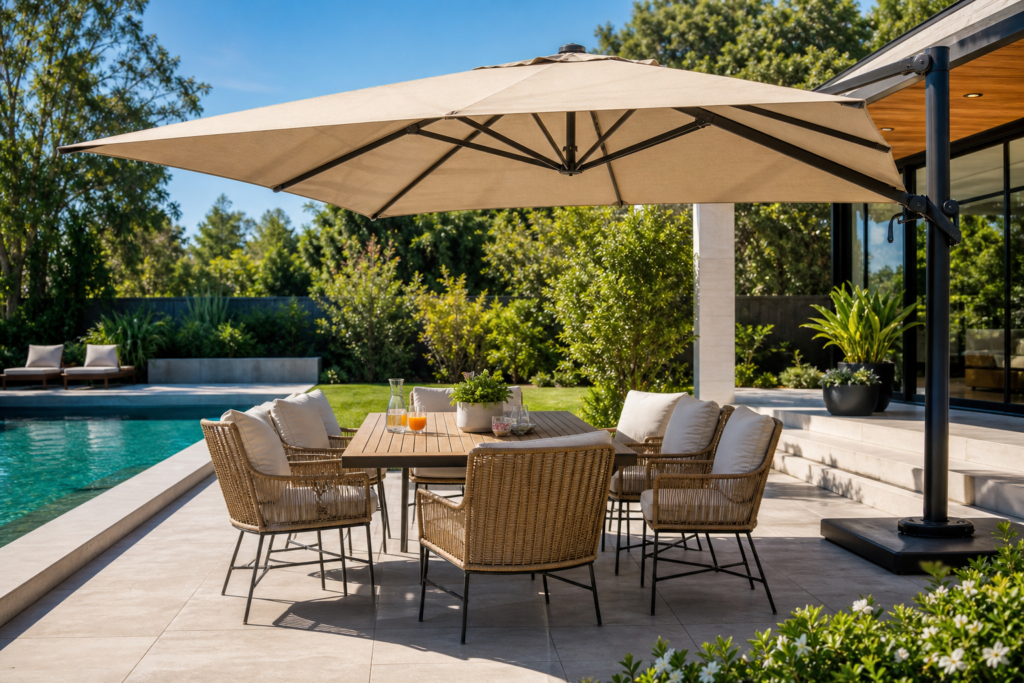
A patio umbrella is generally considered large when its canopy measures about 10 feet or more in diameter or width. Common sizes include:
- 10 to 11 feet: Suitable for many residential dining and lounge areas
- 12 to 13 feet: Useful for large tables, sectional seating, and spacious decks
- 14 to 15 feet: Designed for broad seating zones and some commercial settings
- Oversized rectangular models: Often measure 10 by 13 feet, 10 by 15 feet, or larger
Size classifications vary by manufacturer. Always use the listed canopy dimensions and coverage area instead of relying only on terms such as “large,” “extra-large,” or “oversized.”
How Large Should a Patio Umbrella Be?
A practical rule is to choose an umbrella canopy that extends at least two feet beyond the area being shaded on every side. For example, a 6-foot-wide dining table generally needs an umbrella that provides close to 10 feet of total coverage.
Use these ranges as a starting point:
| Area to Shade | Recommended Umbrella Size |
|---|---|
| Bistro table for 2 | 6 to 7.5 feet |
| Table for 4 | 8 to 9 feet |
| Table for 6 | 9 to 11 feet |
| Table for 8 | 11 to 13 feet |
| Large sectional or lounge area | 11 to 15 feet |
| Multiple seating groups | Multiple umbrellas or a commercial shade system |
The ideal size also depends on sun angle. An umbrella directly above a table may shade it at midday but leave seats exposed during the morning or late afternoon. A tilting or rotating model can compensate for changing sunlight—especially when a larger canopy needs to cover shifting seating positions across the day.
Before buying, measure:
- The width and length of the furniture arrangement
- The clearance around chairs when pulled out
- The height of nearby doors, gutters, railings, and branches
- The available floor area for the base
- The distance between the umbrella and walls or structures
Marking the proposed canopy footprint on the patio with tape or string can help you visualize its actual scale.
Market Umbrella vs. Cantilever Umbrella
Most large patio umbrellas fall into one of two categories: market umbrellas and cantilever umbrellas.
Market Umbrellas
A market umbrella has a center pole that supports the canopy. It can stand independently or pass through the umbrella hole in an outdoor dining table.
This design works well when:
- The furniture has a centered umbrella opening
- You need shade directly over a dining table
- Floor space around the seating area is limited
- You prefer a relatively simple and affordable design
The primary disadvantage is the center pole. It can interrupt sight lines or make certain furniture layouts difficult.
Cantilever Umbrellas
A cantilever umbrella, also called an offset umbrella, supports the canopy from a pole and arm positioned to one side. This leaves the shaded area unobstructed.
A large patio cantilever umbrella is often the better choice for:
- Sectional sofas
- Conversation sets
- Poolside loungers
- Hot tubs
- Tables without umbrella holes
- Flexible outdoor entertaining areas
Many cantilever models rotate, tilt, or adjust vertically. These features improve coverage throughout the day, but the side-mounted design creates substantial leverage. As a result, cantilever umbrellas generally need heavier bases than center-pole models.
If you want to compare different cantilever builds and stability requirements, use this guide: Cantilever Patio Umbrella Buying Guide for 2026: Size, Base & Features.
Choose a Canopy Shape That Matches the Space
Canopy shape affects both appearance and usable shade.
Round and Octagonal
Round or octagonal umbrellas are versatile and pair naturally with round or square tables. They also work well in open seating areas where balanced shade is more important than edge-to-edge coverage.
Square
A square canopy aligns neatly with square dining tables, sectionals, and patios with straight architectural lines. It often provides more usable corner coverage than a round canopy of a similar listed width.
Rectangular
A rectangular large patio umbrella is usually best for long dining tables, outdoor bars, and elongated lounge arrangements. It can cover more furniture efficiently without taking up unnecessary space on the shorter sides.
Match the canopy to the shape of the area rather than choosing based on appearance alone. A rectangular canopy may provide better practical coverage over a long table than a larger round umbrella.
How Heavy Should the Umbrella Base Be?
Base weight is critical. An undersized base can allow a larger umbrella to tip, shift, or rotate unexpectedly.
There is no universal base-weight formula because stability depends on several variables:
- Canopy size and shape
- Center-pole or cantilever design
- Umbrella weight
- Wind exposure
- Base footprint
- Whether the umbrella passes through a table
- Whether the base is freestanding or anchored
- Manufacturer engineering requirements
For many center-pole umbrellas, approximate minimum base weights are:
| Umbrella Size | Typical Starting Base Weight |
|---|---|
| Up to 7.5 feet | 40 to 50 pounds |
| 8 to 9 feet | 50 to 75 pounds |
| 10 to 11 feet | 75 to 100 pounds |
| 12 feet and larger | 100 pounds or more |
These figures are general starting points, not guaranteed safety specifications. A freestanding umbrella typically requires more weight than one supported through a sturdy table.
Large cantilever umbrellas may require several hundred pounds of ballast. Some use fillable base sections designed for sand or water, while others require stacked pavers, steel plates, or permanent surface mounts. Follow the umbrella manufacturer’s base or anchoring requirements exactly.
Sand is usually denser and less likely to leak than water in a fillable base. In freezing climates, water-filled bases must be drained before temperatures fall below freezing unless the manufacturer states otherwise.
Consider Wind Before Choosing the Largest Canopy
A patio umbrella functions like a sail when wind catches the canopy. Larger umbrellas experience greater wind loads, even during ordinary gusts.
No portable patio umbrella should be treated as storm equipment. Wind resistance claims may depend on a specific base, surface mount, canopy position, and controlled test conditions. They do not mean the umbrella can safely remain open in every windy situation.
For a wind-exposed location, prioritize:
- A vented canopy that allows some air to escape
- A reinforced frame
- Strong ribs and hubs
- A correctly sized base
- A locking rotation mechanism
- A surface-mounted installation where appropriate
- A canopy that closes quickly
Close the umbrella whenever it is unattended, during strong or gusty winds, and before severe weather. Use the attached tie or a fitted storage strap to keep the closed canopy secure.
Do not rely on a heavy base alone. Even when the base does not tip, excessive wind can bend the pole, damage the ribs, tear the fabric, or stress the operating mechanism.
Select Durable Canopy Fabric
The canopy is constantly exposed to ultraviolet light, heat, moisture, dirt, and pollutants. Low-quality fabric may fade or weaken after limited outdoor exposure.
Look for the following characteristics:
- UV-resistant or solution-dyed material
- Water-resistant finish
- Mildew resistance
- Strong, reinforced seams
- Replaceable canopy construction
- A clear fade-resistance warranty
Solution-Dyed Acrylic
Solution-dyed acrylic is a premium outdoor fabric known for strong color retention, UV resistance, and durability. It is often used on higher-end residential and commercial umbrellas.
Solution-Dyed Polyester
Solution-dyed polyester can provide good performance at a moderate price. Compare fabric weight, UV ratings, warranties, and manufacturer specifications because quality levels differ.
Standard Polyester
Basic polyester is affordable and widely available. It may be sufficient for occasional or seasonal use, but inexpensive versions often fade faster under intense sun.
“Water-resistant” does not mean waterproof. Patio umbrellas are intended primarily for shade, and water may penetrate seams or fabric during prolonged rain. Allow a damp canopy to dry fully before closing it for storage.
For general guidance on UV safety and exposure basics, see the U.S. Environmental Protection Agency’s UV information: UV Index basics.
Useful Operating Features
A large patio umbrella can be heavy and awkward to control. A well-designed operating system makes daily use easier.
Crank Lift
A crank mechanism opens and closes the canopy by turning a handle. This is convenient for frequent use, but the gears and cable must be strong enough for the canopy’s weight.
Operate the crank slowly and stop if you feel unusual resistance. Forcing the handle can damage the mechanism.
Pulley and Pin
A rope pulley raises the canopy, which is then secured with a pin. This simple design is common on wood and commercial-style umbrellas. It contains fewer internal mechanical parts but requires more manual effort.
Tilt Control
Tilt mechanisms redirect shade as the sun moves. Common types include push-button tilt, collar tilt, crank tilt, and multi-position cantilever tilt.
Check the umbrella’s clearance when tilted. A large canopy may contact walls, roofs, furniture, or people if the surrounding area is tight.
Rotation
Cantilever umbrellas may rotate around the base, often through 180 or 360 degrees. This allows one umbrella to shade different seating zones.
A secure foot pedal or locking handle is important because uncontrolled rotation can damage the umbrella or nearby objects.
Removable Canopy
A removable canopy is easier to clean, repair, or replace. Confirm that replacement fabric is available for the specific model before purchasing, particularly when investing in a premium frame.
Placement and Clearance
Good placement improves both comfort and safety. Position the umbrella so the canopy covers the main seating area without interfering with movement.
Maintain clearance from:
- Grills, fire pits, and outdoor heaters
- Overhead electrical lines
- Roof edges and gutters
- Doors and operable windows
- Tree branches
- Pools and water features where the base could become a trip hazard
- Busy walkways
Never place an umbrella canopy over an open flame or close to a heat source. Fabric can melt, scorch, or ignite, and changing wind can direct heat toward the canopy.
For a dining table, confirm that the pole diameter fits the table’s umbrella hole and the base fits under the table. A table opening supports alignment but does not replace a properly weighted base.
If you’re choosing cushions for comfort under a larger canopy, review this guide to match replacement covers: Outdoor Patio Cushions Pillow Replacement Covers: How to Choose the Right Fit.
Freestanding Base or Permanent Mount?
A portable base offers flexibility, while permanent mounting generally provides a cleaner installation and greater stability.
Freestanding Base
Choose a freestanding base when:
- You need to move the umbrella seasonally
- Drilling into the patio is not permitted
- Furniture arrangements change often
- The site is reasonably sheltered
Large weighted bases may include wheels, but make sure the wheels lock securely. Move the umbrella only when the canopy is fully closed.
Surface Mount
A surface mount may be attached to a concrete slab, reinforced deck, or another suitable structure. It can reduce clutter and provide stronger support for an oversized or cantilever umbrella.
Mounting hardware must suit the substrate, and the structure must be capable of carrying the loads. Deck boards alone may not provide adequate support without reinforcement beneath them.
In-Ground Mount
In-ground sleeves and footings are often used for commercial spaces or permanent residential installations. The required footing dimensions depend on the umbrella design, soil, local conditions, and manufacturer specifications.
Permanent installation does not make it appropriate to leave the umbrella open during severe weather.
How to Measure Your Patio
Before ordering a large patio umbrella, create a simple plan of the outdoor area.
- Measure the furniture at its widest and longest points.
- Include space for people to sit, stand, and move chairs.
- Measure the total patio or deck area.
- Identify walls, railings, stairs, doors, and overhead obstacles.
- Note where the sun falls at different times of day.
- Determine where the base or mount can sit.
- Check the canopy’s open dimensions and height.
- Confirm the umbrella’s dimensions when closed and tilted.
For a cantilever design, include the mast, support arm, base, and canopy swing path in the layout. The canopy may rotate over a wide area even though the base remains stationary.
Care and Maintenance
Regular care extends the life of the canopy, frame, and operating system.
Clean the Canopy
Remove loose dirt with a soft brush. Follow the fabric manufacturer’s instructions for washing, detergent selection, stain treatment, and drying.
Avoid harsh chemicals unless specifically approved. They can weaken protective finishes or cause uneven fading.
Inspect the Frame
Periodically check:
- Rib ends and joints
- Screws, bolts, and fasteners
- Crank cables and pulleys
- Tilt and rotation locks
- Pole connections
- Base hardware
- Rust, cracks, bending, or loose components
Tighten fasteners according to the manual. Replace damaged structural parts before reopening the umbrella.
Store It Properly
Close and tie the umbrella when it is not in use. A fitted cover helps protect against dust, moisture, and UV exposure, especially when the umbrella remains outdoors for long periods.
For winter storage:
- Clean and completely dry the canopy
- Store the umbrella in a dry, sheltered location when possible
- Keep it away from standing water
- Drain water-filled bases before freezing weather
- Follow the manufacturer’s storage position recommendations
Never store the canopy while damp. Trapped moisture encourages mildew and can stain the material.
Common Buying Mistakes
Choosing by Diameter Alone
Canopy diameter does not tell you whether the umbrella will fit the furniture arrangement, avoid obstacles, or provide shade at different sun angles. Consider shape, tilt, height, and placement.
Buying an Undersized Base
A base that technically fits the pole may still be too light. Verify the required weight or mounting system for the exact umbrella model and installation.
Ignoring the Base Footprint
Cantilever bases can occupy substantial patio space. Review their full dimensions, including any ballast sections, before ordering.
Assuming Every Umbrella Is Windproof
Wind ratings have conditions and limits. No rating eliminates the need to close the canopy during unsafe weather.
Overlooking Replacement Parts
A strong frame may outlast its canopy, cord, or crank. Availability of replacement fabric and hardware can make a more expensive umbrella a better long-term value.
Focusing Only on Purchase Price
An inexpensive oversized umbrella may use lower-grade fabric, weak ribs, or a short-lived crank. Compare the total package, including the required base, cover, warranty, replacement parts, and delivery costs.
Frequently Asked Questions
What size umbrella do I need for a six-person table?
A 9- to 11-foot umbrella is typically suitable for a table seating six people. The exact size depends on the table’s dimensions and the amount of shade needed around occupied chairs.
Is an 11-foot patio umbrella too large?
An 11-foot umbrella is not too large for many standard patios, especially when shading a table for six to eight people or a substantial seating arrangement. It may be oversized for a narrow balcony or compact deck. Measure the open canopy footprint and surrounding clearance before purchasing.
Can a large patio umbrella be used without a table?
Yes, but it requires a base rated for freestanding use. The table provides some lateral support to a center pole, so an umbrella used without one often needs a heavier base. Cantilever umbrellas are specifically designed to provide freestanding shade but have substantial ballast or mounting requirements.
How much wind can a large umbrella handle?
The safe limit depends on the umbrella, base, mounting method, condition, and wind characteristics. Gusts are especially unpredictable. Follow the manufacturer’s published limits and close the canopy before conditions approach them. When no clear rating is provided, take a conservative approach.
Should an outdoor umbrella be left open all day?
It can remain open while supervised in suitable weather, but it should be closed when unattended or when wind increases. Keeping it closed when shade is not needed also reduces UV exposure and wear.
Do patio umbrellas block UV rays?
Quality outdoor canopies can reduce direct UV exposure, but performance varies by fabric and construction. Look for a stated UPF rating. Shade does not eliminate exposure from reflected or indirect ultraviolet radiation, so normal sun-protection measures are still important.
Is a dark or light umbrella better?
Dark fabrics often provide strong glare reduction and may show some stains less readily, but they can absorb more heat and may reveal fading over time. Light fabrics can make a seating area feel brighter but may show dirt. Fabric quality, UV rating, and solution-dyed construction matter more than color alone.
Are cantilever umbrellas worth the cost?
A cantilever umbrella is often worth the higher price when unobstructed shade and adjustability are priorities. It is particularly useful for lounge furniture, pools, and tables without center holes. The additional expense usually comes from the frame, rotation and tilt hardware, and heavier base system.
Can a patio umbrella stay outside in winter?
Some frames can remain outdoors when closed and covered, but indoor or sheltered storage usually extends their service life. Snow, ice, freezing water, moisture, and winter wind can damage both the umbrella and base. Follow the care instructions for the specific materials.
Final Buying Checklist
Before purchasing a large patio umbrella, confirm the following:
- The canopy extends far enough beyond the furniture
- The shape matches the dining or lounge area
- The open canopy has adequate overhead and side clearance
- The pole placement works with the furniture
- The base meets the manufacturer’s weight requirements
- The mounting method suits the patio or deck
- The frame is appropriate for local weather conditions
- The canopy has suitable UV and fade resistance
- Tilt and rotation controls are easy to operate
- Replacement canopies and parts are available
- The product warranty clearly covers relevant components
- There is a practical way to close, cover, and store the umbrella
The best large patio umbrella is not necessarily the widest model. It is the one that provides sufficient coverage, fits the available space, uses a properly engineered support system, and can be operated and maintained safely. Careful measurements and attention to base requirements will do more for long-term satisfaction than canopy size alone.



Add comment